
Laila
From Camp to Catwalk: One Girl’s Slow Fashion Uprising

Curiosity maketh the girl
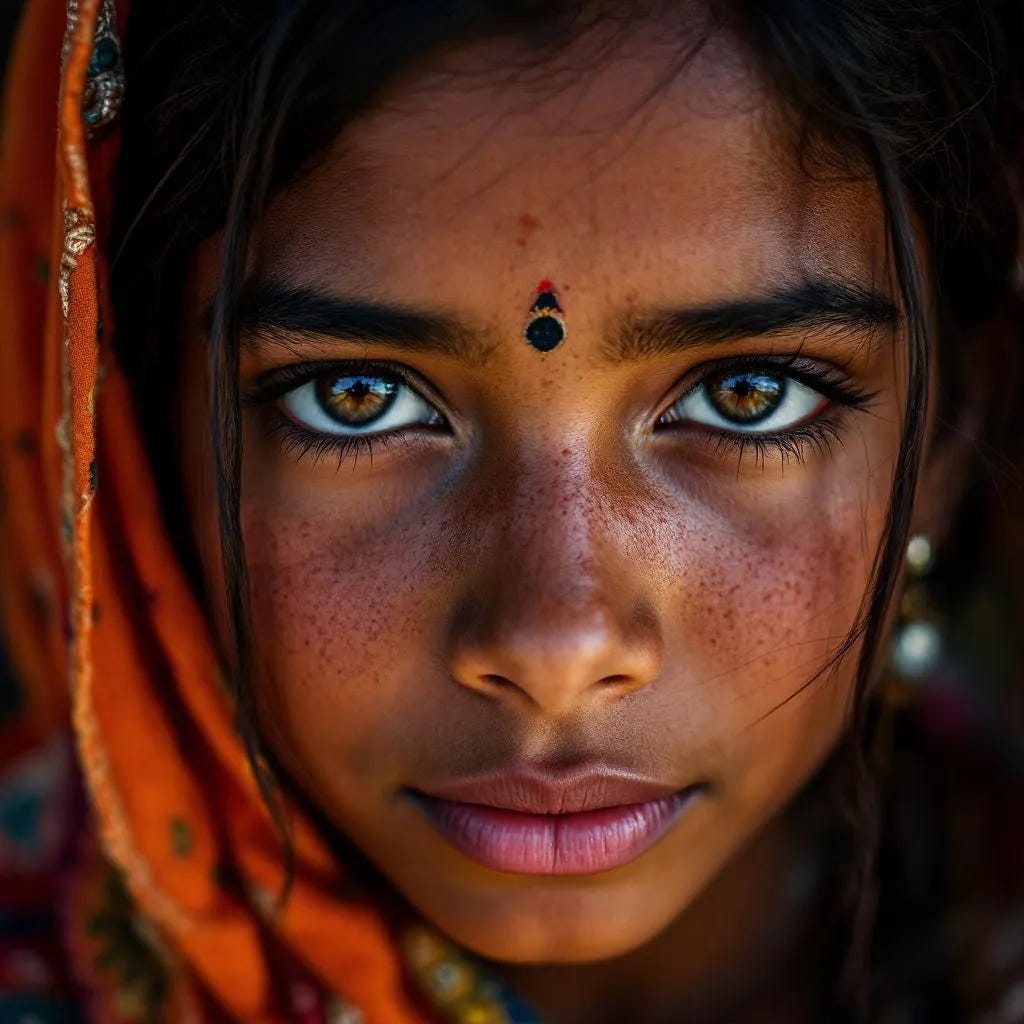
Some people come into the world unintentionally.
Some come uninvited.
For the most underprivileged, it can feel like they were never meant to be here at all.
To be an Untouchable or Dalit is a birthright without rights. To be a Rohingya refugee in Bangladesh is to carry a citizenship that no country claims. And in Cox’s Bazar, their paths cross.
The daughter of a Dalit father and a Rohingya mother checks every box of what it means to be uninvited. With the cards stacked against her from the start, no one would’ve questioned if she’d bowed her head, and slipped quietly into the role life had carved without her consent.
But her circumstances shaped her into something unyielding. Rejected by both communities, unrecognized by the country she lived in, and shut out of education and opportunity, Laila learned how to be a party crasher.
It was monsoon season, and the rain had been falling for hours, steady, unrelenting, as if the sky had nothing better to do. Inside the dim shelter, the air was thick with the scent of damp earth and flatbread, and the occasional mosquito buzz. Laila sat cross-legged on the floor, her small fingers gently smoothing out a torn book page she had rescued from the street, its ink smudged but still legible in parts.
Her mother, Yasmin, was kneading dough in a metal bowl, her wrists moving in tired circles, her gaze fixed on nothing in particular.
Laila glanced up and looked at her mother.
“Mom,” she whispered with all the courage she could muster, “you know if I could go to school… I’d learn faster than the boys.”
Yasmin let out a slow sigh, not looking at her.
“I know, dear. I know you would,” she said, her hands still working the dough. “But schools are not meant for girls like us.”
“Why not?” Laila’s voice trembled with frustration. “My hands work like theirs. My mind works better than theirs… I want to know things.”
Yasmin paused. Then, slowly, she reached over and brushed a wet strand of hair from her daughter’s forehead, her touch soft but sad.
“Because we were not born in the right place,” she said quietly. “Or to the right people. The world has strange rules, and we are always on the wrong side of them.”
Laila lowered her gaze, then lifted it again, her small face set with quiet defiance. “But that’s not my fault.”
Yasmin’s voice caught in her throat. “No,” she said, barely above a whisper. “It’s not.”
She glanced up at the patched tin roof, where rainwater dripped rhythmically into rusted pans. “A leaking roof doesn’t care who’s underneath,” she said. “It just keeps dripping.”
Laila said nothing for a moment. Then, still holding the crumpled book in her lap, she spoke, steady and sure.
“Then I’ll learn anyway. Somehow.”
Yasmin gave her a faint smile, one that tried to hide the ache behind it. “You already are, my little monsoon.”
Laila learned in secret. Not in a classroom, but in the corner of her refugee shelter, from crumpled newspapers used as packaging, from discarded schoolbooks blown in by the wind.
She pieced letters together like fragments of a broken mirror, sounding them out softly under her breath, copying words onto scraps of cardboard with charcoal, ash, or anything that would leave a mark.
She watched, listened, guessed. When foreign volunteers came with food or first-aid kits, she memorized the labels. From them, she picked up English, too.
No one taught her formally, but the world, in its chaos and refuse, left clues. And Laila, uninvited as she was, claimed them.
She began working in a sweatshop at the age of nine.
It wasn’t a job so much as an inevitability. Her father had already lost the little he had. Her mother, stateless and voiceless, had no legal access to employment. So when a neighbor mentioned "light factory work” in Dhaka, Laila went.
At first, she trimmed loose threads from shirts bound for faraway malls. Then came buttons, zippers, hems. Ten hours a day, six days a week. No contract, no breaks, just the rhythm of machines and oppressive heat.
Laila never applied to work for the biggest fashion brands. They came to her through tangled subcontracts, whispered promises, and nameless middlemen with clipboards. But there were the labels on the clothes Laila stitched. Names she couldn’t pronounce initially, but recognized on billboards, in magazines, and in influencers’ video clips.
By age 12, she was working full-time in garment production, in a workshop that technically didn’t exist. Hidden three floors above a motorbike repair shop in Dhaka, it had no signage, and no escape route.
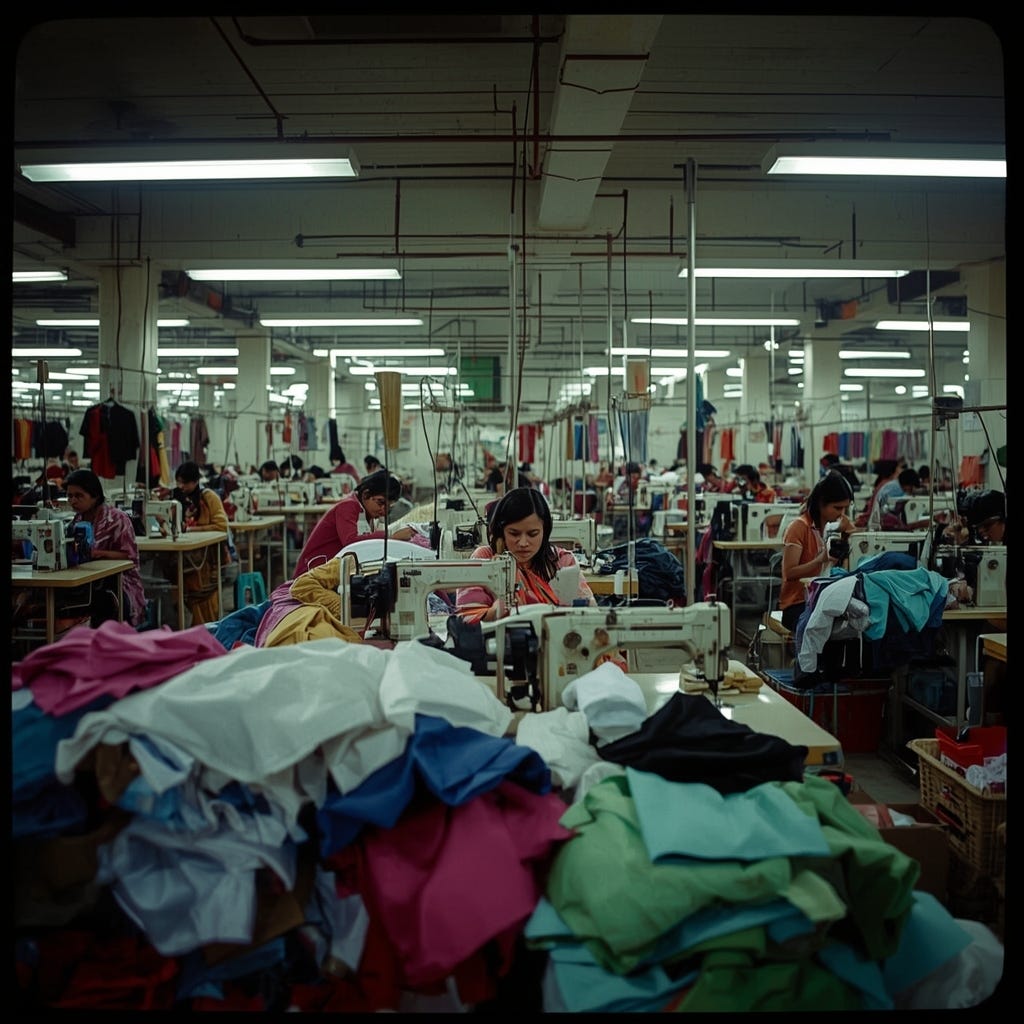
Despite the horror of the Tazreen fire and the Rana Plaza collapse, which had sparked European supply chain legislation, little had actually changed on the ground in Dhaka’s sweatshops.
Her ability to learn fast and without a fuss was Laila’s superpower. She never questioned her child-labor years. Those she quietly filed away under “experience,” the one thing that had kept her small family afloat.
But she did question the vast mountains of fast fashion the industry kept churning out, and the toxic materials and processes used to make them. She didn’t need a degree to understand the damage. She could smell it in the dyes, feel it in the dirty runoff that flowed straight into the river, and see it in the eyes of her often sickly co-workers.
The whole business just didn’t sit right with her. It didn’t sit right with anyone doing the dirty work. And it shouldn’t have sat right with the big brands and consumers in the West either, but many had mastered the fine art of cognitive dissonance, one of humanity’s weirdest survival tricks: the ability to look straight at a mess, shrug, and keep scrolling. Because shopping, online and in air-conditioned malls, aka the Land of Lost Weekends, had become a pastime of bored consumers everywhere.
Laila’s curious mind quickly led her to start imagining ways the industry could be different. She had never heard the word sustainability, but she didn’t need to. She simply knew, deep down, that things couldn’t possibly be right the way they were.
In her quiet quest for knowledge, Laila often slipped out of the camp where she stayed and into a nearby internet café. The owners, charmed by the bright, curious girl, let her browse for free. There, she stumbled into a world she never knew existed, of fruit- and mushroom-based leather, algae- and bacteria-grown textiles, and even fermented microbial silk. She was especially captivated by microalgae pigments and bacterial dyes, their vivid colors as alive as the organisms they came from. The idea of plant-based fur made her laugh out loud, she couldn’t quite picture who would wear something so odd, or why. But she kept reading, wide-eyed and curious, quietly building a secret library in her mind.
She even managed to set up a LinkedIn account. And suddenly, a whole world of like-minded people opened up. Until then, she’d assumed the planet was overrun by mindless fast fashion hyper-consumers. But to her surprise, she discovered a growing tribe of slow fashion designers, activists, sustainable brands, models, and curious thinkers who cared just as much as she did, and were just as fed up with the industry’s dirty secrets.
And while all this was exhilarating, she had no idea where her journey might lead.
