
The Climate Fight Needs You: From Bystander to Changemaker

Here’s something wild: 89 percent of people want more climate action, but most think others don’t. That false assumption is paralyzing us. It breeds silence. It delays actionable, scalable solutions. Not only that, it feeds the illusion that no one else cares.
The climate crisis is fueled by overconsumption, greed, fossil fuels, and political failure. But it’s also driven by something quieter: miscommunication.
Mainstream media often sidelines climate change, treating it as a niche topic instead of the defining issue of our time. It fails to give people the context, the facts, and the hard truths they deserve. Worse still, increasing censorship, especially in the U.S., is making it harder to have open, honest conversations about real solutions.
This newsletter is a space for solution-driven, positive, and inspiring stories that challenge the status quo. Because let’s be honest: we’ve read the reports, heard the warnings, and seen the gloomy headlines.
We know enough. We’ve talked enough. Now it’s time to act.
So I asked my network: What climate topics aren’t getting the attention they deserve? Based on insights from that LinkedIn survey, this newsletter will dive into inspiring stories flying under the radar but critical to change. Together, we’ll explore:
🌱 Biodiversity
🥕 Agrifood systems
⚖️ Climate justice
🤝 Community resilience
🧠 Health and mental well-being
🌍 Adaptation
💡 Lifestyle shifts
📚 Education
🚀 And the new opportunities that arise from climate action.
If you're concerned about the climate emergency, this is your space. Each week, I’ll share stories that are hopeful, grounded in fact, and designed to inspire action.
I’m a writer and content creator with a background in international development cooperation in agriculture and forestry. Passionate about climate change and global collaboration, I created this space to highlight the momentum we are building and to provide an antidote to the doom and gloom, the pushback, and the growing censorship on climate. My goal? To fill in the gaps left by mainstream media and remind you that change is happening.
Free subscribers get a regular, inspiring piece focused on one topic. Paid subscribers get additional deep dives on underreported issues with exclusive content (1-2x/month), and the opportunity to participate in polls to shape future content.
Get ready for climate news that just might make you smile. And let’s move from awareness to action, together.
Thanks for being here.
The culprits
The World Economic Forum's Global Risks Report 2025 ranks extreme weather events, which will become more frequent and more intense, second and first in the 2-year and 10-year outlooks. Who done it? The usual suspects: Historically, industrialized nations have been the largest contributors to greenhouse gas (GHG) emissions, largely due to their extensive use of fossil fuels and rapid industrialization. In 2025, China, the United States and the countries that make up the European Union are the three largest emitters. Consumers are responsible for more than 60 percent of all direct and indirect emissions, and it is therefore clear that, collectively, we can play an important role in the fight against the climate crisis. Fun fact: Changes in our behavior and lifestyle can result in a 40-70 percent reduction in greenhouse gas emissions, according to the Intergovernmental Panel on Climate Change (IPCC).
So yeah, there you have it. We consumers need to take a long, hard look at ourselves. And ask, “Are we the problem?” (Spoiler: kinda, yeah, though it’s not just us…) But hang in there, we’ve got what it takes to turn this around. Then again, the fossil fools are perhaps totally on the verge of doing the right thing any day now. Okay, sarcasm over.

“How do we sleep while our beds are burning?”
Not too bad, all things considered. Thanks for asking. But kicking the can down the road, waiting for political and legal guidance, structural change, or technological solutions, is not the best option, because:
all COPs so far did not have any impact on GHG emissions, which are growing linearly (and will continue to do so),
the World Meteorological Organization notes that the amount of heat-trapping greenhouse gases in the atmosphere hit a new record in 2022, and it's not going to stop rising anytime soon,
investment in fossil fuels has grown by seven percent to more than USD 500 billion in 2023. Governments collectively still plan to produce more than twice the amount of fossil fuels in 2030 than would be consistent with limiting global warming to 1.5°C, despite 151 national governments committing to net-zero emissions,
despite a record increase in the use of renewable energy in 2023, fossil fuel consumption continued to rise, according to an annual review of world energy by the Energy Institute. Global fossil fuel consumption climbed to a record in 2023, pushing emissions above 40 gigatons of CO2 for the first time,
data from one of the world's oldest and most respected carbon dioxide observatories suggests that atmospheric levels of the greenhouse gas rose at a record rate in 2024,
in Germanwatch.org's 2024 Climate Change Performance Index (CCPI), which tracks the climate performance of 63 countries and the EU, no country scores high enough in all categories to receive an overall "very high" rating in the index,
the agreement reached at COP28 commits countries to "transitioning away from fossil fuels in energy systems, in a just, orderly and equitable manner, accelerating action in this critical decade, so as to achieve net zero by 2050 in keeping with the science." If that sounds underwhelming and lame to you, you are not alone. There is no intention to phase out fossil fuels and there are loopholes that would allow their continued use - even after 2050,
COP29 even tried to turn back the clock on this agreement and was a huge disappointment with the minimal funding that was agreed: the COP process is failing us year after year,
only a few climate change policies have led to significant reductions in carbon emissions. What this means for countries around the world is that the impact of their policies has so far been very limited,
last but not least, the U.S. is once again pulling out of the Paris Agreement and making the most out of its oil and gas reserves.
I just stop here because it's too depressing to keep listing the many ways in which humanity is merrily engineering its own demise, rant over (for now).
Political leaders have largely failed to mobilize climate action at anywhere near the pace and scale needed, despite decades of dire warnings and wake-up calls. According to the 2023 Extreme Weather Congress, it has become clear that the Paris Climate Agreement of 2015 has failed. The frequency of extreme weather events, such as heat waves, droughts, and floods, and their intensity, are ever-increasing. Science clearly attributes this to climate change and, for decades already, the pattern is following climate scientists’ predictions. No place is safe anymore, and the associated human suffering is tremendous and unacceptable. And isn’t it mind-boggling that our lifestyles make us complicit in our own suffering and responsible for the suffering of others who are not complicit in the climate emergency? But with this recognition, we can choose to be the change we want to see in the world, and we can change the things that we no longer accept. There is simply no escaping the responsibility.
All right, all right, rant reloaded…
Told you so, but you wouldn’t listen!
The Club of Rome’s 1972 report on the Limits to Growth pointed out that unlimited growth is impossible on a planet with limited resources. More than 50 years later, and in the middle of a climate crisis, gross domestic product (GDP) growth continues to be the core metric for an economy’s well-being. But it does not reflect at all the well-being of people and ecosystems. Moreover, and this is not without irony, GDP accounting enters the costs of environmental disasters on the credit side. A new paradigm for a healthy world needs to look at what sectors should grow, what should remain as it is, and which sectors should be reduced. But it looks like decision-makers are not necessarily going to make the switch anytime soon, there are too many opposing interests and mindsets to accommodate. To make matters worse, it’s not only scientists armed with graphs and data who are influencing political decisions, but also lobbyists with huge amounts of money.
What remains is that each of us can choose to rethink our lifestyle and consumption patterns, and together we are a force to be reckoned with. So what would it take to mobilize more people?
What if climate change coverage was, well, better?
For over 40 years, fake news has been spreading the myth that climate action is a threat, while the real threat is the ever-growing climate crisis. News about the climate emergency, on the other hand, is dominated by doom and gloom, and climate science can be hard to communicate. Although more recently, there have been admirable attempts to wrap it in comedy. Adding to the confusion is the present debate around green growth vs. degrowth to fight the climate crisis, which revolves around somewhat untested theories, is without historical precedent and infused with much speculation on political scenarios. This is unsurprising, as we have never faced such an existential predicament. Too soon to tell, said Zhou Enlai to Henry Kissinger when asked about the success of the French Revolution. And that more or less sums up the conversation about the long-term strategy. What we do know is that the crisis is real and urgent, and our focus, therefore, should be on actionable concepts, small and big things that work, collective action, and inspiring stories for all concerned citizens of the world. In a language that is easily understood by everyone.
A 2021 survey, the People’s Climate Vote by UNDP, which covered 50 countries with over half of the world’s population, came to the conclusion that relevant policies aiming at forest and land conservation, renewable power sources, climate-friendly agriculture, and green business and jobs had wide-ranging support among respondents.
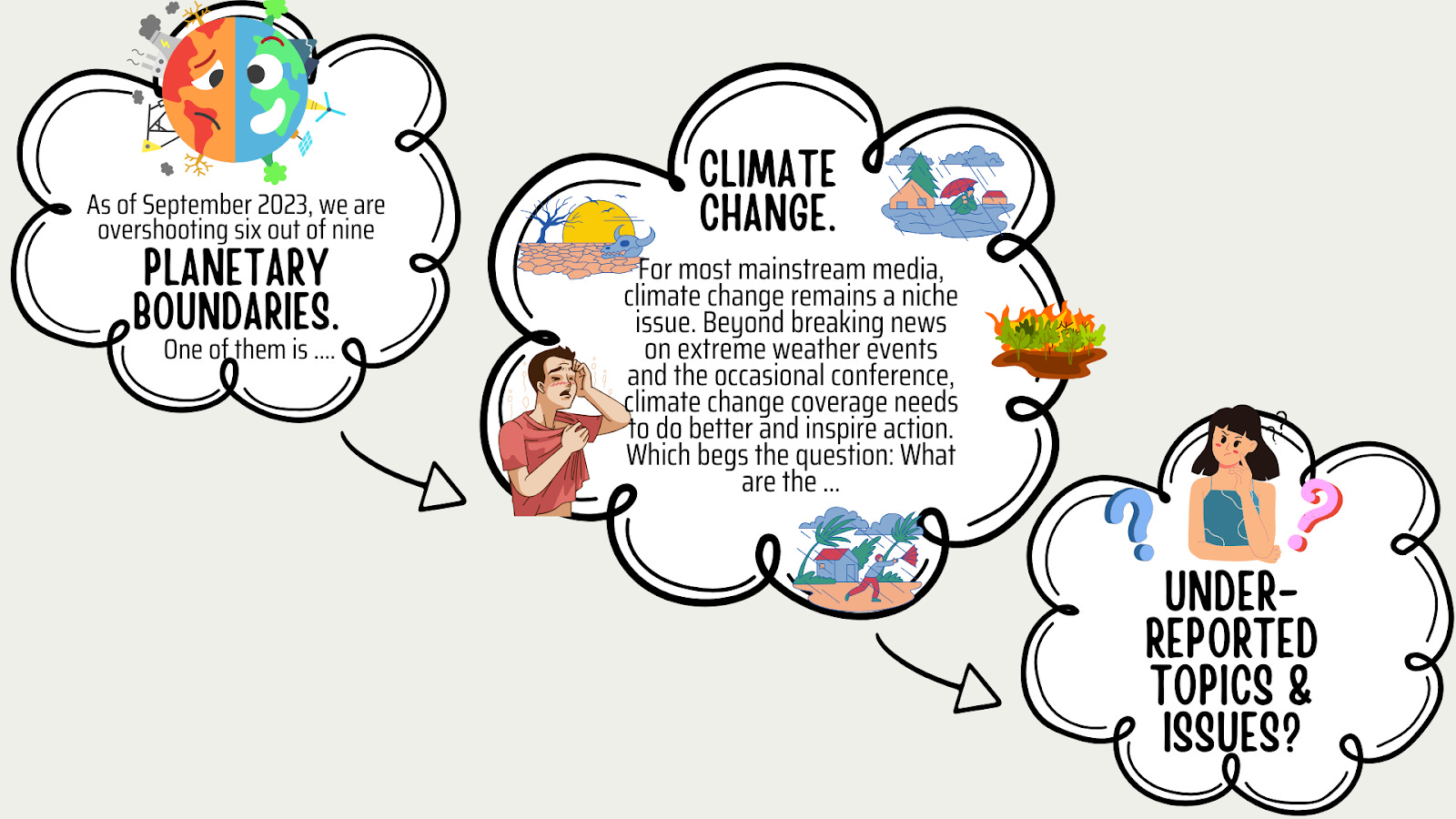
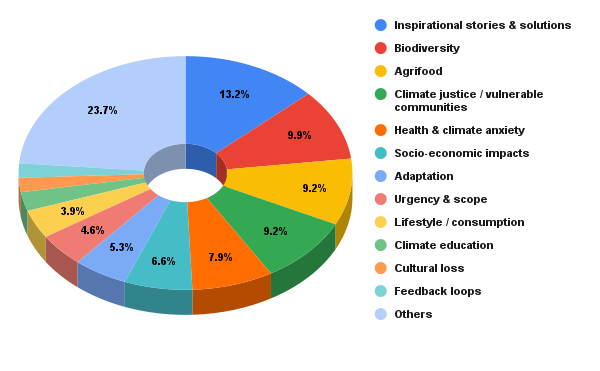
While climate change is only one of nine planetary boundaries, a concept that aims to define the environmental limits within which humanity can safely operate, it is arguably the most pressing one. The problem is that adequate coverage of the climate crisis, its interconnectedness, causes, and solutions is prevented by the very nature of the mainstream media's business model. And so, motivated by the need to get a perspective closer to the truth than is provided by the mainstream media, I carried out a LinkedIn survey at the turn of the year 2023/2024, around COP28. 107 scientists, experts, thought leaders, entrepreneurs, and activists responded: thank you so much for participating, sharing, and giving some of your valuable time!
Their feedback shows: Existing solutions and positive, inspiring stories are at the top of the list and an overarching aspect of under-reported climate change topics. Incidentally, a recent study involving 59,000 participants confirmed that pessimism may actually be counterproductive. This is followed by effects on biodiversity/biosphere and the consequences for the climate, agriculture/livestock/food, climate justice, health and mental health, socio-economic impacts, adaptation, urgency and scope of the crisis, lifestyle and consumption, climate education, cultural loss, and feedback loops. By the way, making the agrifood system a priority in national strategies to address climate change has taken center stage at COP28 for the first time. Unfortunately, there were no meaningful results, while FAO’s roadmap for the transformation of agrifood systems falls short by significantly understating the impact of the livestock industry, focusing on inflated technological solutions.
How to encourage more climate action by the people?
The scientific message isn't getting through (or perhaps it's too soon to tell after only four decades of dire warnings), and climate activists are often meeting with resentment and even criminalization. Many people are concerned, but reluctant or unsure how to get involved. Or wondering if it makes any difference at all, because, since COP28, we know that oil and gas producers have no intention of phasing out fossil fuels. And as far as individual consumption patterns are concerned, we seem hardwired to acquire more and more stuff, when the reasonable thing to do seems to involve sacrificing quality of life. But this is a myth and needs to be debunked. The challenge, therefore, is to craft a compelling and motivating value proposition, one that shows doing the sensible thing isn’t about sacrificing quality of life, but about enhancing it. It's about better opportunities that are within reach, not years away; right here, not far from home. Win-win, duh.
How to frame this message for different audiences seems to be the million-dollar question, though.
If what you are doing is not working, do something different
Mitigation aims to limit climate change and involves reducing the flow of heat-trapping greenhouse gasses into the atmosphere, either at the sources of these gasses or by enhancing carbon sinks (oceans, forests, and soils). But it is clear now that the goals of the Paris World Climate Convention are not being achieved, and the responsibility lies squarely with the countries driving climate change.
Adapt or perish
A study published in The Lancet Planetary Health [Vogel, J. and Hickel, J. 2023] shows that, despite a partial decoupling of GDP growth from GHG emissions, none of the 36 high-income countries studied has achieved green growth. The planet’s economies continue on their path of endless growth, while emitting more and more GHG. Besides, even with a hypothetical zero emission scenario, climate impacts are already a reality and will continue to affect future generations, possibly for millennia. These facts are important considerations in the climate crisis debate and need to inform intensified adaptation efforts to deal with what is surely coming. As it stands, the world is unprepared for climate disasters and, while adaptation is highly cost-effective, funding is inadequate and even declining.
Drowning in information, starving for wisdom
Over-consumption, greed, fossil fuels, and political failure are at the heart of the climate crisis. But it's also about miscommunication. Those of us in the business of communication should focus on the types of information, stories, and topics that are most effective in inspiring and empowering concerned citizens and communities to take meaningful climate action. The use of appropriate media and platforms to reach different audiences is equally important.
Responses to our LinkedIn survey show how a perceived lack of information leads to inspired and creative suggestions for better information. As I had hoped, respondents did not simply repeat under-reported topics, but actually took them to the next level - hats off to you! In a nutshell, the key is to share stories that are local, relatable, and showcase the strength of people working together. To shake off that 'freeze' mode and get everyone in the 'fight' mode, ready to take on the climate challenge, we need stories that turn climate change into a relatable event. We also want heartwarming success stories, like communities switching to renewable energy, businesses being eco-superheroes, individuals making lifestyle changes, local communities and young minds stepping up with nature-based solutions, showcasing grassroots efforts for adaptation and resilience. A real powerhouse are personal stories that connect with people's experiences. And there needs to be a dash of mental health support because feeling overwhelmed is perfectly normal. Coverage should always consider available solutions to the issues raised in a story, as readers are more likely to respond positively if they know others are doing the same. This behavioral pattern has recently been confirmed in a survey across 125 countries, which showed widespread support for climate action, but cooperative behavior remaining contingent on others doing the equivalent.
Climate actions often remain isolated, not integrating into broader plans. To address this, it's crucial to infuse climate risk knowledge into all aspects of life, keeping it simple and action-oriented. Communication needs to reshape the narrative, emphasizing positive lifestyle changes, and reassuring that living standards will improve. Arts and humanities-centered approaches, especially from vulnerable regions, can convey the urgency of climate action well. More social scientists should be contributing to the conversation. Recognizing diverse communication styles is crucial, with personal stories and videos resonating strongly, particularly from those already affected by climate change.
It has further been suggested to connect climate issues with personal health and food, including experiences from health professionals, as individuals are more likely to engage when it concerns their well-being. Climate science plays a central role, with an emphasis on showcasing the multitude of people working on various climate-related aspects to counteract feelings of slow progress at international levels. The introduction of climate change education, community development projects, school initiatives, webinars, training, and social media coverage is proposed for reaching vulnerable communities. Emphasis should be on cultural context and local languages, rather than fitting stories into Western narratives.
Music, puppet shows, nature festivals, and community workshops are recommended for engaging and inspiring action, aligned with individual and community efforts. Stories reflecting on past generations' practices in environmental care are also suggested.
Get your story straight
How a story is told can make or break the message. Stories can evoke an emotional response and emotions can be drivers of attitudes, behavior and decisions. Storytelling is a way for us to make sense of the world. We believe anecdotes over evidence, and are 22 times more likely to remember a story than any other communication. There are certain storytelling elements (relatable characters, transformation, light-hearted, everyday people) and communication strategies that better resonate with the broader public and motivate them to engage with climate issues. Shared values such as family, community, and saving money are important ingredients in communication strategies to connect with our audiences. We need to prioritize those when creating content. After all, the story of the climate crisis is the story of all of us, not just the story of governments and corporations.
Our LinkedIn survey showed that effective storytelling for climate engagement should focus on positive, action-oriented, community-based narratives that emphasize solutions over problems. This includes presenting human hero stories, challenges, solutions, and ending with a call to action. However, some respondents questioned the focus on heroes. Either way, stories of affected individuals and communities humanize the climate crisis. Localizing and adapting messages for diverse audiences, using arts, culture, influencers and opinion leaders goes a long way toward effective communication. Stories that focus on people's values, such as their family, their community, or their spiritual beliefs, were confirmed as being very powerful. In addition, climate action should be framed as a driver of economic growth and job creation.

If you want to go quickly, go alone, if you want to go far, go together (African Proverb)
Communities experience the effects of climate change first-hand and are therefore key stakeholders in the fight against climate change. But participation, collaboration, and empowerment of local communities and grassroots efforts in addressing the climate crisis have often been overlooked, underrated, or even belittled. This narrative can be changed, and stories or examples of community-driven climate action that should receive more attention from the media to encourage similar efforts elsewhere need to be put front and center.
In our survey, local communities and grassroots efforts emerged as a key factor in the fight against climate change, a finding that has recently been confirmed by the World Economic Forum. They are seen as central to bridging gaps in knowledge and motivation. Community-driven initiatives are viewed as more than feel-good stories; they serve as engines for broader change, even influencing corporate and government action. The impact of local projects, from community solar initiatives to forest conservation, goes beyond addressing climate and environmental crises; it sends powerful messages about priorities. The need for greater coverage extends to remote communities, showcasing inspiring stories that are often overshadowed by larger organizations in climate finance discussions. But the playing field is shifting, urging a shift in focus and funding to larger, vulnerable communities.
A two-pronged approach has been proposed, involving broad-based grassroots efforts to build community connections and discussion platforms, followed by direct action groups. From Nepal to Nigeria, stories of youth-led climate projects illustrate the effectiveness of grassroots initiatives that offer solutions rooted in local contexts. Communities are being recognized as the driving force, contributing over 50 percent of climate action, and there's a call for more mainstream media attention to local initiatives.
Efforts to combat climate change are diverse, ranging from circular economies to regenerative agroforestry. The need for global networks, collaboration and well-documented success stories is highlighted. In conclusion, respondents consider local communities and grassroots efforts not just as players in the climate game, but as game-changers. If we report and share their stories properly, they can be scalable blueprints and create a ripple effect, inspiring others to join the fight and fostering a global network of effective climate action.
The spirit is willing, but the flesh is weak
Surveys from 2023 provide a strong indication for the way forward. Many Europeans feel concerned about the climate crisis, want to take personal action, and back government policies to tackle the problem. But the more an action requires them to change their way of life, the less likely they will be to back that action. Across the pond, three-quarters of Americans believe climate change is happening. But they are less convinced that it is caused mostly or entirely by human activity. 15 percent of Americans don’t believe that climate change is real, however.
Please take it personally
The challenge for us is to put this mindset to work, in other words, to close the attitude-behavior gap. Relational conversations with a focus on action have been suggested to inspire people to become active climate crisis fighters. It will be crucial to cultivate awareness, engagement, and a sense of collective responsibility. There is a lot of compelling and accurate information about the climate crisis, its impacts, and the urgency of action. But we need to showcase opportunities, success stories, and solutions to demonstrate that positive change is possible. Perhaps most importantly, for most people, stories with a personal angle are easier to engage with than graphs and statistics, or more precisely, science. Personal stories help reduce psychological distance, the idea that climate change will only affect people in the distant future, or in a distant location.
“Remember when you were young? You shone like the sun.”
Isn’t it the most logical thing to put young people in charge of decision-making when it comes to the climate crisis? The simple, naked truth is that the young will inherit Earth and live on an overheated planet, with all the disastrous consequences their elders are leaving them, thank you very much. Contrary to conservative thinking, Gen Z is smart enough to understand the rules of the game, the science, and the way out of the paper bag (Noam Chomsky would agree). They can and they will take a long-term view, and bold ideas like system change and degrowth are concepts young minds can handle without having hysterical fits. This is certainly frightening for some, but change is unavoidable. And clearly the consequences of inaction should be more frightening. So let the future be as cool as our kids!
Another important suggestion came out of the survey: Journalists, civil society members and community representatives from the Global South need much more access to decision-making events and forums. This is often simply a question of securing funding. Information on where to find it and how to apply would go a long way toward a fairer representation. Consequently, there would be a better information flow to constituencies in the Global South, who typically rely on and trust in local media in local languages.
Acknowledgements
The feedback to my LinkedIn survey, which has informed this essay, has been remarkable. It’s inspiring to see so many passionate people committed to confronting the climate crisis. There's real hope that, together, we can turn the tide. But no rest for the wicked, because the fossil fools are not done yet. In the meantime, a heartfelt thank you to all who contributed. You know who you are.